
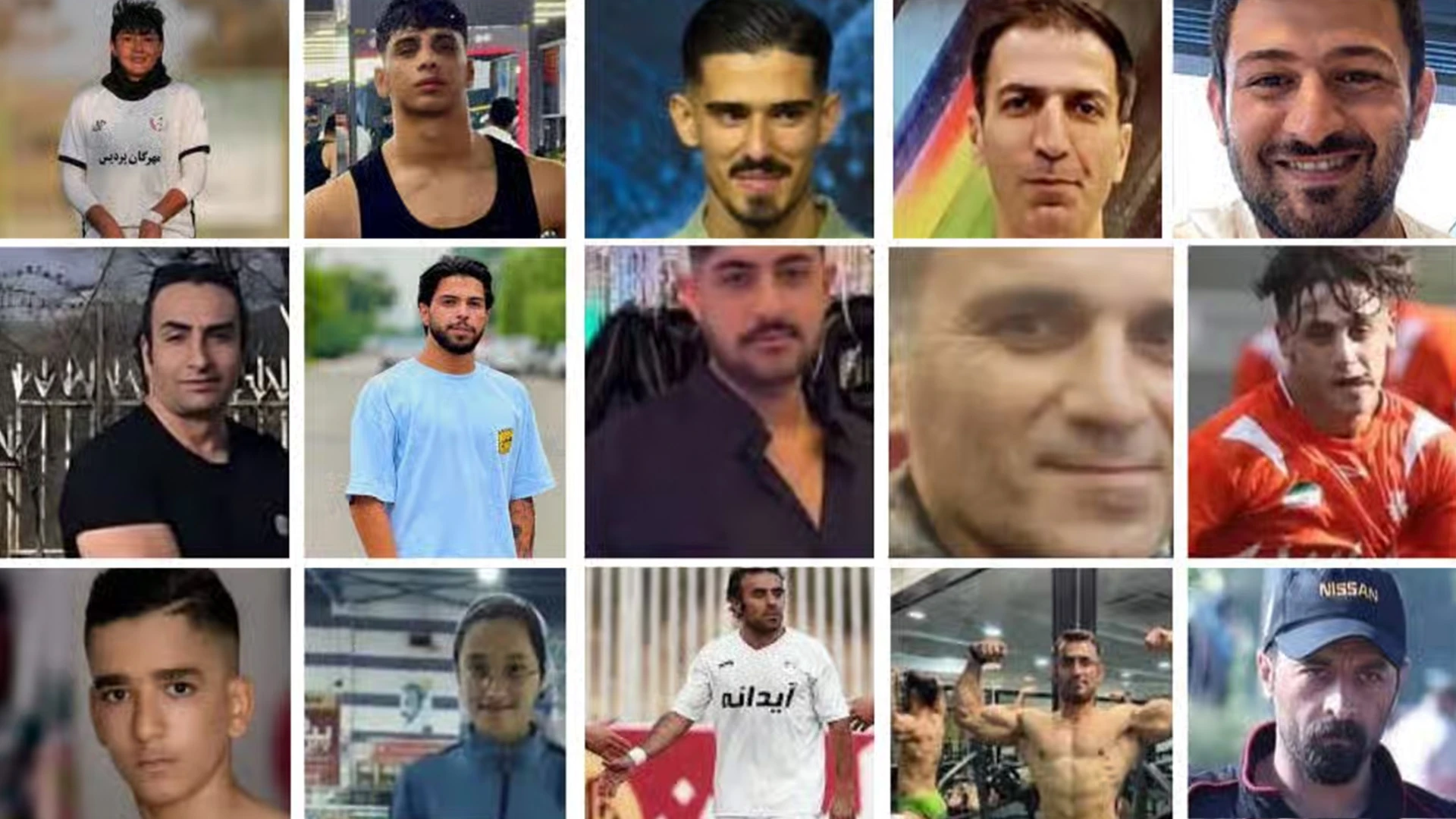
Twenty-one-year-old Amirhossein Vandalvand was a young footballer and bodybuilder who dreamed of building a life abroad. His life ended violently and abruptly after he was shot and killed by security forces after leaving practice to join anti-government protests. He is one of at least 124 Iranian athletes killed during the January 2026 demonstrations. Amirhossein, his fellow athletes, and thousands of other Iranians who died during the January protests deserved a chance at a normal life. They deserved to join millions of others around the world in watching the World Cup, cheering for their teams, and connecting with their fellow fans.
Many others’ lives remain on hold and at risk as the Islamic Republic has expanded its use of public intimidation, arrest, and torture. While international athletes competed under bright stadium lights, former Iranian national team goalkeeper Rashid Mazaheri sat behind bars for publicly criticizing Ali Khamenei. For weeks, his family was kept in complete darkness, having received no information on his whereabouts or condition. As his wife wrote online: “His life is in danger, but his honor remains untouched.”
Iranians today are increasingly choked by twin vises. The first is the 47 year rule of the Islamic Republic, a government founded and sustained on force and fraud, whose tactics of fear, intimidation, and murder prove that it has long ago lost any semblance of legitimacy. The second is the ongoing devastation brought about by the American and Israeli war against Iran, which has led to thousands of civilian deaths and increasing economic instability.
Our job outside of the country is to ensure that these stories are heard, and to support the people of Iran in any way that we can.
Behind the Reach: Turning Stories into Impact
Exposing human rights abuses during a media blackout does not happen automatically. Since the start of the war, United for Iran’s researchers and social media team documented and published 306 unique stories, generating over 32 million views and reaching 17 million people. Stories highlighting persecuted athletes alone were viewed more than 6 million times.
Our work provides a crucial lifeline to the families, friends, and community of political prisoners. Every view, share, and comment represents an intentional refusal to let state violence happen in the dark. High-reach digital campaigns serve a vital function: they raise the political cost of repression for authorities, reassure political prisoners and their families that they are not forgotten, and provide international media with verified reporting when traditional journalism is barred from the ground.
The repression inside Iran has not stopped, and the work of exposing it requires constant adaptation. Bypassing state-level censorship, verifying documentation, and maintaining high-impact outreach across digital platforms requires sustained resources. You can support us in our work by:
Following us on Social Media and helping these stories gain a wider audience, or by
Making a Tax-Deductible Donation to help us maintain the staff, technology, and resources needed to keep up this crucial work.